In Vivo Evaluation of the Anti-Inflammatory Activity of Wild Forest Honey from Konawe and Its Potential as a Nitric Oxide Inhibitor in Macrophage Cells

Downloads
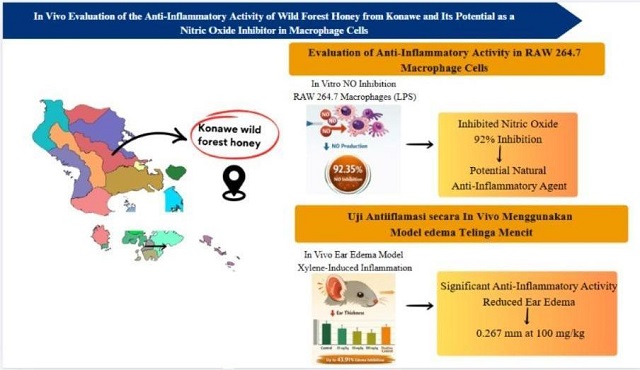
Forest honey is a natural product derived from nectar of wild plants, rich in bioactive compounds such as flavonoids and phenolics, with potential antioxidant and anti-inflammatory properties. Konawe Regency, Southeast Sulawesi, is known for forest honey production, yet its biological activity has been scarcely studied. This study aimed to evaluate the in vivo anti-inflammatory effect of Konawe forest honey and its potential as a nitric oxide (NO) inhibitor in macrophage cells. In vivo activity was assessed using a xylene-induced mouse ear edema model, while NO inhibition was evaluated in LPS-stimulated RAW 264.7 macrophage cells. Results showed that forest honey significantly reduced ear edema. At 45 minutes, ear thickness was 0.967 ± 0.115 mm for the negative control, 0.233 ± 0.058 mm for the positive control, and 0.300 ± 0.100, 0.333 ± 0.058, and 0.267 ± 0.058 mm for doses of 25, 50, and 100 mg/kg body weight, respectively, with inflammation inhibition percentages of 43.91%, 43.70%, and 32.81%. ANOVA followed by Tukey’s post hoc test indicated significant differences among treatments (p < 0.05). In the NO assay, forest honey showed inhibition up to 94.35 ± 5.40%, with significant concentration-dependent effects (p < 0.05). Konawe forest honey shows promising potential as a natural anti-inflammatory agent through suppression of edema formation and nitric oxide production in macrophage cells.
Downloads
Copyright (c) 2026 Jurnal Mandala Pharmacon Indonesia

This work is licensed under a Creative Commons Attribution 4.0 International License.