Influence of CYP2C19 Metabolism and Ethnic Variability on Clopidogrel Effectiveness in Ischemic Stroke: A Review

Downloads
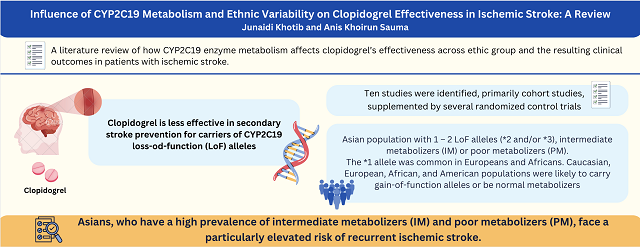
Clopidogrel is widely used to prevent secondary stroke and coronary heart disease. Its effectiveness depends on conversion to the active metabolite, a process mediated by cytochrome P450 2C19 (CYP2C19). Clopidogrel is less effective in secondary stroke prevention for carriers of CYP2C19 loss-od-function (LoF) alleles. This review examined research from 2019 to 2024 on how CYP2C19 enzyme metabolism affects clopidogrel’s effectiveness across ethic group and the resulting clinical outcomes in patients with ischemic stroke. A literature review was conducted using online research journals, with the population, intervention, comparison, and outcomes framework guiding the research questions. Ten studies were identified, primarily cohort studies, supplemented by several randomized control trials, which strengthen the evidence base. Most data came from Asian population with 1 – 2 LoF alleles (*2 and/or *3), including intermediate metabolizers (IM) or poor metabolizers (PM). The *1 allele was common in Europeans and Africans but found less frequently in Asians. Caucasian, European, African, and American populations were likely to carry gain-of-function alleles or be normal metabolizers. Bleeding risks did not differ significantly between carriers and noncarriers of the CYP2C19 LoF allele. In IM and PM, alternative P2Y12 inhibitors, such as prasugrel or ticagrelor, are recommended to optimize therapy.
Downloads
Copyright (c) 2025 Jurnal Mandala Pharmacon Indonesia

This work is licensed under a Creative Commons Attribution 4.0 International License.